Helping kids with homework without the frustration


I lost my temper over an Algebra II worksheet. Not shouting exactly, but my voice changed, and my son’s face changed with it. That was the night I worked out that helping kids with homework is a skill, and I did not have it. Offering a YouTube channel to teach algebra was not helping.
Good news: it is a skill you can pick up in about a week. Most of what goes wrong at that table is not your kid being lazy, and it is not you being a bad dad. It is the timing, and it is the kind of help you are handing over.
Here is the short version of what turned our evenings around:
We stopped starting homework the second he walked in the door.
We moved to the kitchen table instead of a bedroom desk.
I started asking one question instead of explaining three times.
We set a timer, and I kept quiet until it went off.
I stopped correcting his work before he finished it.
No reward chart. No laminated schedule. Nothing I had to buy.
Why helping kids with homework usually backfires
Because most of the help we give is the wrong kind. A 2024 meta-analysis pooling 28 studies and more than 378,000 students found a weak negative link between parents getting involved in homework and how their kids performed. More involvement, slightly worse results.
Then the researchers split involvement into types, and one type came out positive: autonomy support. That means paying attention to your child's own ideas and backing their own attempts at the problem. This gives them agency and they are in control. Feeding them content and policing the page did not show the same benefit.
I read that twice because I had been doing the content and the policing. Both of them.
The fix is not helping kids with homework less. It is helping them with homework differently.
My job is project manager, not answer key
I run the session, I do not supply the answers. Harvard's Graduate School of Education describes the parent's role here as a homework project manager, and giving myself a job title changed more than any single technique did.
Managers do not do the work. They keep it moving. They ask what is due, agree the order it gets done in, check there is a pencil in the pencil case, then stay out of the way.
Once that was in my head, a stuck kid stopped feeling like my failure. He was not stuck because I had explained it badly. He was just stuck. That reframe is most of what I know about helping kids with homework.
What actually changed our evenings
Four changes did nearly all the work, and none of them are clever.
We stopped starting at four o'clock
Straight after school was the worst possible time, and it took me two years to notice. He had been sitting still, following instructions and managing other people since eight in the morning. Asking him to keep going was asking for a fight.
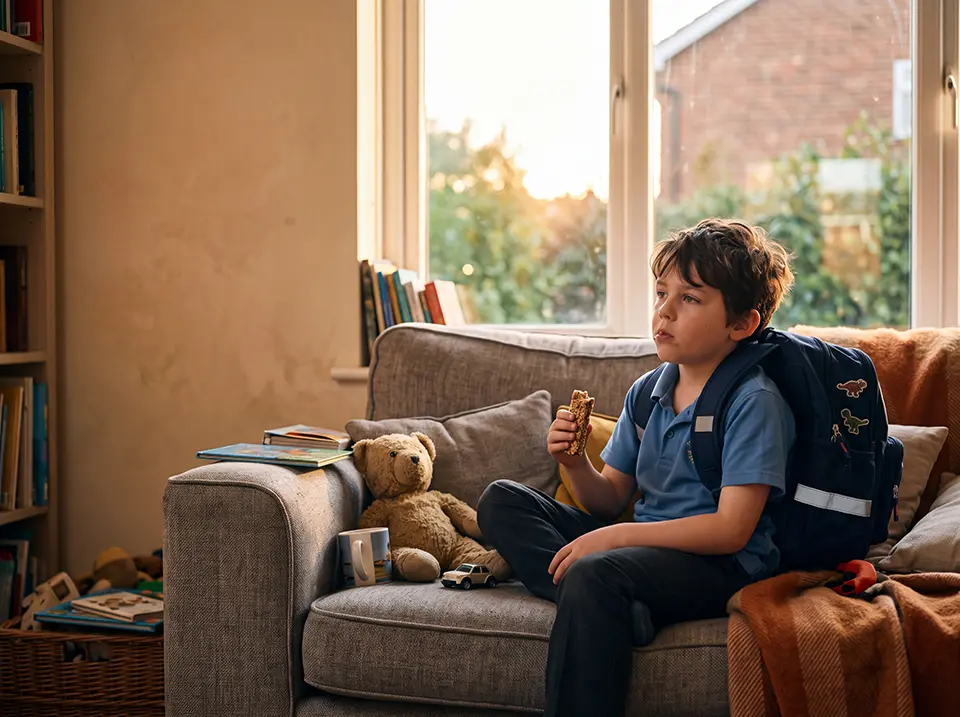
Now it is snack, half an hour of doing nothing or something they wanted to do, then work. That one change beat every tip on this list. A homework routine for kids only holds if the start time matches when they actually have something left.
We moved to the kitchen table
Harvard's advice for kids thirteen and under is to have them work at a communal table with a parent nearby, because a bedroom desk lets a reluctant kid quietly avoid the whole thing for an hour.
That is the opposite of the quiet dedicated study space advice you see everywhere else. In our house the kitchen island won. He felt less alone with it, and I was close by without standing over him.
It allowed my wife or I to prepare dinner while he was doing his work. We are both there, but we are doing different things. They also call this body doubling, and it works well for kids who have ADHD.
I swapped explanations for one question
I used to explain, then explain again slower, then explain a third time with my patience visibly draining. It never worked once. He heard me; but he was stuck, and a fourth version of my voice was never going to fix that.
Now I ask one thing. What part do you already get?
It is slower. It also works, because whatever he arrives at is his, and he still has it the next morning.
We put a timer on it
He estimates how long the assignment will take. I set the timer. Then he works without interruption until it goes off, and I do not answer questions during that window either.
The estimating is half the point. Kids are terrible at judging how long things take, which is exactly why a bit of homework at eight o'clock becomes a crisis at ten.
I remember one night we got a late start. We grouped the homework into three parts and put a time limit on each one. If he finished early, he got a break before the next one started. It worked out great!
How long should homework actually take?

About ten minutes per grade level per night, across all subjects combined. Both the National Education Association and the National PTA support that guideline, and plenty of school districts have written it into policy.
Grade | Rough nightly ceiling |
1st grade | 10 minutes |
3rd grade | 30 minutes |
5th grade | 50 minutes |
8th grade | 80 minutes |
12th grade | About 2 hours |
Treat it as a ceiling, not a target. If your kid is regularly doubling it, that is useful information rather than a personal failing. It is a conversation to have with the teacher, not something to grind through at your kitchen table every night at nine.
What to do when it goes sideways anyway
Stop. Nothing gets learned when one of you is upset, and the worksheet is not worth the relationship.
We have a rule now. If it turns into a fight, we stop for ten minutes. It is not a punishment and it is not a reward, it is a reset. Same move that sorted out our going to bed fight, and the same one behind getting a response the first time I ask.
If it is still a mess after the reset, the work goes unfinished and I email the teacher in the morning. That felt like failing the first time I did it. It is not. A teacher would far rather see what your child can do on their own than a page you did for them at nine at night.
The harder version is letting them hand in something you know is wrong. I am still not good at that. But learning when to let them figure it out is most of the job, and homework is where I get to practice. It is important to ensure your kids understand the material ahead of the test.
The older my complex kids get, the more I ensure they are self-regulated, before we begin starting homework. If they are not in the right mindset, it is not worth starting.
When it is not a homework problem
Sometimes the routine is right and the fight keeps happening anyway. That is worth paying attention to rather than pushing through.
Talk to the teacher if the same type of work is impossible week after week despite real effort, if homework is regularly eating into sleep or meals, or if your child seems genuinely distressed rather than just annoyed. Ask about an assessment if it carries on.
Attention and learning difficulties often show up at the homework table first, because that is where a kid has to start something boring with nobody watching. If any of that sounds familiar, what I have learned about ADHD as a dad is a starting point.
I am a dad and not a clinician, so the real next step is a professional. My wife and I discovered that with our youngest and found out he had ADHD. It did not show up until high school, and we found out when he was 16.
Homework questions dads ask me
Should I sit with my child the whole time?
Nearby, yes. On top of them, no. Sit at the same table and do your own thing. Pay a bill, read something, answer your own email. Your presence the useful part, not your commentary.
What if I do not understand the work myself?
Say so out loud. "I have no idea how they want you to do this" is a perfectly good sentence. Then help them find the resource instead: their notes, the textbook, the teacher's page. Teaching a kid how to find an answer beats handing them one.
How do I help my child with homework without fighting every night?
Change the time before you change anything else. Most homework battles are a tired kid meeting a tired parent at the wrong hour. Move the session thirty minutes later and see what that does before you try anything more complicated.
Is it ever okay to just give them the answer?
Occasionally. Last question, eight thirty at night, and everyone is finished. But if it is your default, your kid learns that being stuck is a signal to sit and wait for you.
What if they refuse to start at all?
Ask for something tiny. Not "do your homework". Try "get the math sheet out of your bag and put it on the table" or “what is one thing you can do tonight?” Starting is the hard part for a lot of kids, and once the sheet is out the rest usually follows.
Where we ended up
The algebra worksheet is a story we tell now. He is fine at math. I am fine at not being his teacher.

Nothing changed because he got easier to teach. Helping kids with homework got easier the moment I stopped trying to be the person with the answers and became the person who keeps the session running. Everything else on this page is scaffolding around that one shift.
If your evenings are rough in other ways too, the rest of the everyday fixes that have actually worked for me is where I keep them.


Comments